
Duct Sealing & Air-Leak Diagnostics in Spring Hill
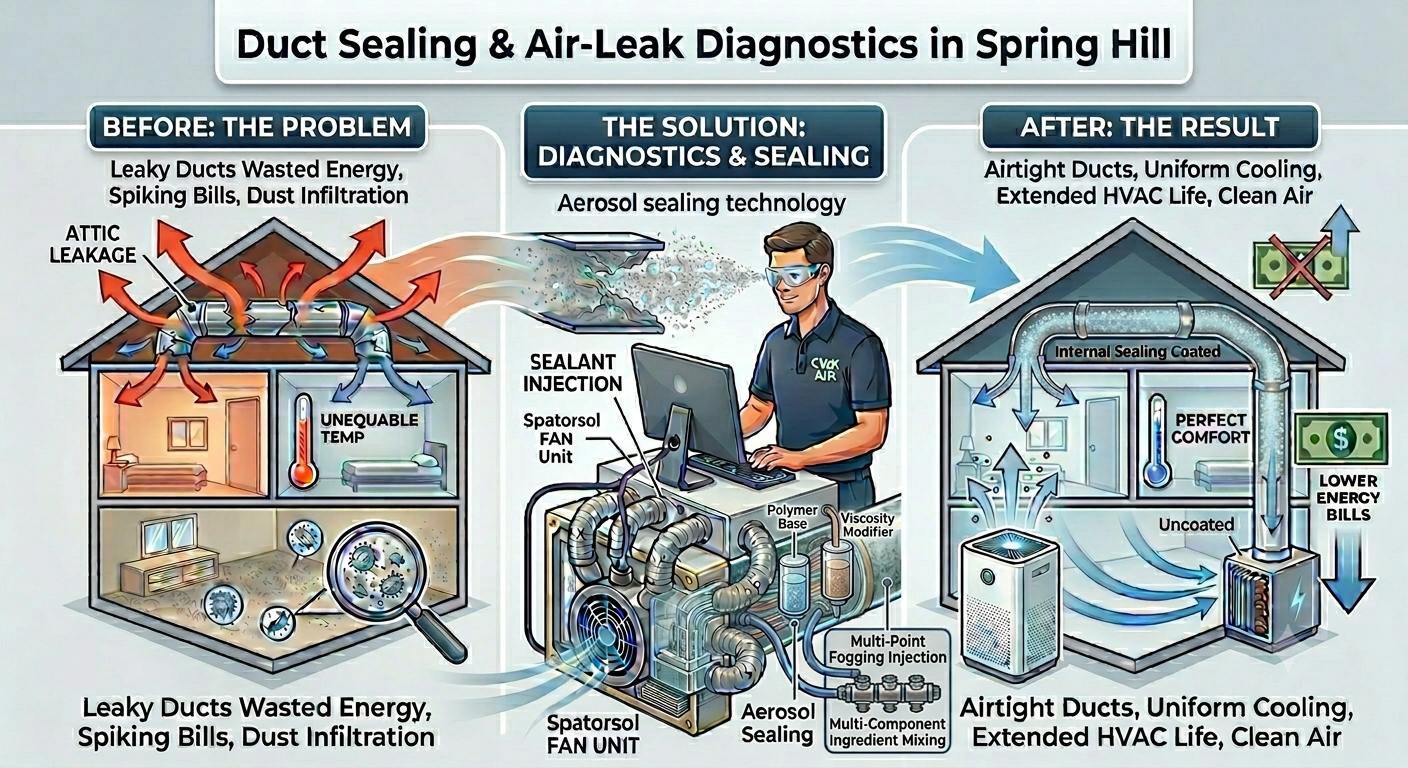
When most Spring Hill homeowners notice their monthly energy bills creeping upward or feel a stubborn warm zone in the master bedroom, they immediately blame their air conditioning unit. They schedule an AC tune-up, change the air filter, or begin budgeting for a premature system replacement.
However, the real culprit behind high utility costs and uneven cooling is often completely invisible. It lies tucked away behind your drywall, buried underneath layers of attic insulation, or running beneath your floors.
According to national energy studies, the average home loses roughly 20% to 30% of the conditioned air moving through its duct system due to leaks, holes, and poorly connected joints. In the demanding, high-humidity climate of Central Florida, that lost air translates directly to wasted money and degraded indoor comfort.
If your HVAC system is working overtime but your home still feels humid, dusty, or unevenly cooled, it is time to look into specialized air-leak diagnostics and advanced duct sealing solutions.
The Anatomy of a Leaky Duct System: How Small Gaps Cause Big Problems
To understand why duct leaks are so destructive to your home’s efficiency, it helps to understand how your central HVAC system operates. Your air conditioner acts as a closed-loop system. The supply ducts push chilled, conditioned air out into your living spaces, while the return ducts draw warm air back into the system to be cooled and filtered.
When gaps, cracks, or disconnected joints interrupt this loop, two major problems occur:
- Conditioned Air Escape (Supply Side Leaks): Chilled air that you have already paid to cool escapes into unconditioned spaces like your blistering hot attic or crawl space. Your living areas never receive this air, forcing your system to run longer cycles to reach the temperature set on your thermostat.
- Unconditioned Air Infiltration (Return Side Leaks): When return ducts have leaks, they act like a vacuum, sucking in 130-degree attic air, humidity, insulation fibers, dust, and outdoor allergens directly into your respiratory loop. This severely degrades your indoor air quality and forces your AC evaporator coil to work twice as hard to dehumidify the air.
Signs Your Spring Hill Home Needs Air-Leak Diagnostics
Ductwork naturally deteriorates over time. As a home settles, or as the intense Florida heat stresses the tape and mastic sealants used during original construction, gaps inevitably form. If you live in an established neighborhood or an older Florida ranch style home, keep an eye out for these telltale signs of duct failure:
- Spiking Energy Bills: A sudden or steady increase in your monthly power bill—without a corresponding change in outdoor temperatures—signals that your system is losing structural efficiency.
- Hot and Cold Spots: If your living room feels ice-cold but a back bedroom remains stifling and humid, poor airflow dynamics caused by localized duct leaks are often to blame.
- Excessive Dust and Allergens: Finding a thick layer of dust on your furniture just days after cleaning? Leaky return ducts are likely pulling fine particles out of your attic and distributing them throughout your home.
- High Indoor Humidity: Florida is famous for its ambient humidity. If your home regularly feels sticky or damp even when the AC is running, your ductwork may be pulling moisture-laden air into your living spaces.
The Science Behind Air-Leak Diagnostics
You cannot fix a problem until you know exactly where it is. Because the majority of your duct network is physically inaccessible, traditional visual inspections are rarely enough to identify every microscopic point of failure. This is where professional air-leak diagnostics come into play.
Using advanced pressure-testing equipment, certified HVAC technicians can precisely measure the exact percentage of air leakage within your system. The process involves temporarily sealing off all your supply and return registers and attaching a specialized calibrated fan to your ductwork.
By pressurizing the system, technicians can monitor airflow dynamics and determine the precise rate of air escape. This diagnostic phase establishes a definitive baseline, proving exactly how much performance your home is losing before any physical repairs even begin.
Aerosol Sealing vs. Traditional Methods: The Permanent Solution
For decades, the standard approach to fixing leaky ductwork involved manually applying foil tape or liquid mastic sealant to accessible joints. While this method works well for exposed, easy-to-reach duct runs, it is completely useless for the sections of ductwork hidden behind walls, ceiling joists, and tight architectural spaces.
Modern HVAC technology has completely transformed this process through advanced aerosol sealing technology. Instead of trying to patch the ducts from the outside, this innovative approach seals your ductwork from the inside out.
Here is how the aerosol duct sealing process works:
- System Isolation: Technicians block off all registers, grilles, and sensitive HVAC components (like the furnace or air handler coil) to isolate the interior of the duct network.
- Pressurization and Injection: The automated sealing equipment pressurizes the isolated ducts and injects a safe, non-toxic aerosolized sealant vapor into the air stream.
- Automated Detection: As the pressurized vapor travels through the ductwork, it naturally seeks out any area where air is escaping.
- Micro-Layer Bonding: When the suspended sealant particles pass through a leak, they catch on the edge of the hole. Particle by particle, they stick to each other, building a flexible, airtight bond that permanently seals holes, cracks, and loose connections.
- Verification Testing: Once the computer tracking indicates that the leaks have been closed, a post-repair pressure test is conducted. This provides homeowners with documented, before-and-after verification of the exact energy waste eliminated.
The Long-Term Benefits of Investing in Professional Duct Sealing
Opting for professional duct sealing and air-leak diagnostics delivers immediate, compounding returns on your investment.
1. Reduced Monthly Operating Costs
By stopping conditioned air from escaping into your attic, your HVAC system won't have to work nearly as hard to keep your home comfortable. This results in shorter system runtimes and immediate savings on your monthly cooling bills.
2. Extended HVAC Lifespan
An air conditioner running under the strain of leaky ducts suffers from accelerated wear and tear. Overworked compressors and fan motors fail years ahead of their expected lifespan. Sealing your ducts restores balanced airflow dynamics, lowering component stress and preventing costly unexpected breakdowns.
3. Enhanced Indoor Air Quality
Sealing off return-line gaps eliminates the vacuum effect that pulls attic dust, insulation particulates, mold spores, and pest dander into your home's breathing air. This creates a much healthier living environment for family members who suffer from asthma, seasonal allergies, or upper respiratory sensitivities.
4. Consistent, Balanced Comfort
No more moving from room to room trying to avoid hot spots. Properly sealed ducts ensure that the exact amount of conditioned air calculated for each room actually arrives there, balancing temperatures evenly throughout your entire floor plan.
Protect Your Home with Local HVAC Expertise
Managing the unique architectural styles and intense climate demands of Central Florida requires localized knowledge. Whether you are dealing with an older property that has original, degrading duct materials or a newer build experiencing uneven airflow, cookie-cutter fixes simply will not cut it.
If you are ready to stop wasting money on lost air, lower your utility bills, and experience true, balanced comfort in every room of your house, schedule a professional evaluation. Contact the experienced team at Craig W. Krueger Air Conditioning and Heating to book an expert duct sealing and air-leak diagnostics appointment for your home today.