
20 South Florida Cities with the Lowest Humidity (Ranked #1–20)
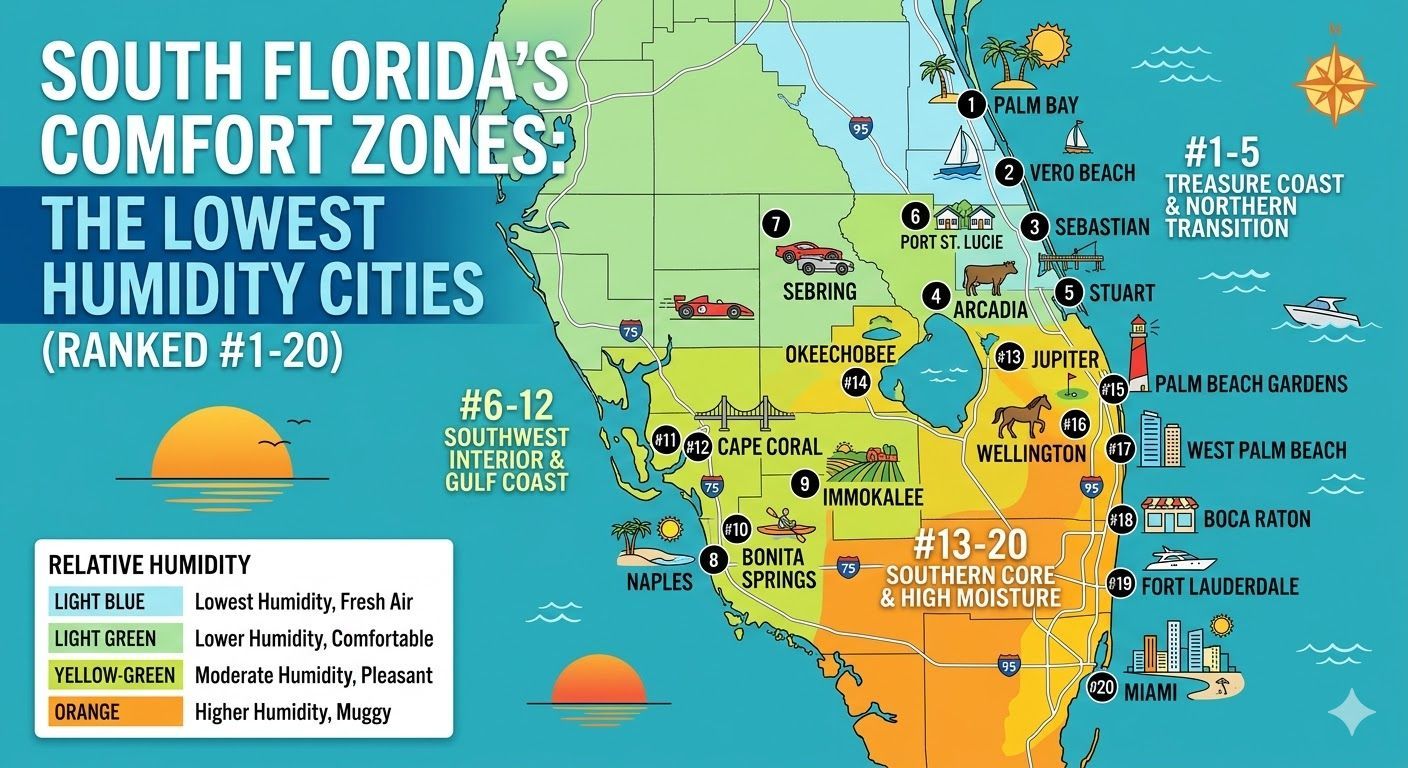
South Florida, famous for its beaches, palms, and... let's face it, humidity. The thick, sticky air can be oppressive, leaving you reaching for the A/C or dreaming of a dryer climate. While truly dry, low-humidity environments like the Southwest are rare in the Sunshine State, some areas do offer a noticeable respite from the standard South Florida steam bath.
This article moves away from the typical humidity charts (which often show very subtle differences) and instead explores 20 cities and areas in South Florida where you're most likely to find more comfortable conditions, especially compared to the dense, humid core of Miami or the humid swamp fringes. We'll examine the geographic factors that play a role and offer a strategic approach for those seeking a less sweaty Florida lifestyle.
The Truth About South Florida Humidity
Let's manage expectations right from the start. You're not going to find Arizona levels of dry heat in South Florida. The entire peninsula is influenced by the warm waters of the Atlantic Ocean and the Gulf of Mexico, making high humidity a fundamental part of the climate. However, there are nuances. A few key factors contribute to variations in perceived and measured humidity across the region:
1. Elevation and Distance from Large Water Bodies: This is a major factor. Areas further inland, away from the direct, moisture-laden breezes of the Atlantic or the Gulf, and slightly elevated above the surrounding swampy lowlands, generally experience slightly lower relative humidity levels.
2. Prevailing Winds and Sea Breezes: While sea breezes bring cooling, they also carry moisture. Cities that are more exposed to consistent, dryer easterly winds, or those located in specific configurations that allow for the mixing of drier air from further inland, can feel less humid.
3. "Perceived" vs. "Relative" Humidity: This is important. Relative humidity is the percentage of moisture the air holds relative to its maximum capacity at that temperature. However, perceived humidity, often influenced by temperature and wind speed (the "heat index"), is what truly matters for your comfort. A city with slightly higher relative humidity but lower temperatures and a strong breeze can feel much more comfortable than a slightly less humid city that's hotter and still.
4. Seasonality: South Florida humidity has distinct seasons. Winter (roughly November to April) is generally drier and much more pleasant, with lower temperatures and less frequent rainfall. Summer (May to October) is the true humidity monster, with high temperatures, abundant rainfall, and consistently high humidity.
1. Palm Bay
Average Humidity: ~60–64% Technically sitting at the northern gateway of South Florida, Palm Bay is the undisputed champion. Its position on the East Coast allows it to catch drier air masses moving down from Central Florida before they hit the tropical moisture wall further south. It consistently records some of the lowest dew points in the region.
2. Vero Beach
Average Humidity: ~65–67% A favorite for retirees who can’t stand the "stickiness" of Miami, Vero Beach benefits from being far enough north to receive more frequent dry-air cold fronts in the winter. Its coastal breezes are often crisper than those in the southern counties.
3. Sebring
Average Humidity: ~68% Sebring wins because of its elevation and inland location. At about 130 feet above sea level (high for Florida!), it sits on the "Lake Wales Ridge." This elevation, combined with its distance from the ocean, allows moisture to dissipate more quickly than in the coastal lowlands.
4. Arcadia
Average Humidity: ~69% Located deep inland in DeSoto County, Arcadia escapes the direct maritime influence that keeps the coasts perpetually damp. During the winter dry season, Arcadia can feel genuinely "crisp" compared to the humid coastal cities.
5. Stuart
Average Humidity: ~70% Stuart marks the beginning of the "low humidity corridor" on the Atlantic side. Because it is north of the heavy Everglades influence, the air here tends to cycle through more frequently, preventing that "stagnant swamp" feel common in the south.
6. Port St. Lucie
Average Humidity: ~70% Similar to Stuart, Port St. Lucie is far enough north and has enough inland development to keep average humidity slightly lower than its neighbors in Palm Beach County.
7. Naples
Average Humidity: ~71% Naples is widely considered the driest city in Florida in terms of total rainfall, which often correlates with more "low humidity" days. While the Gulf is right there, the specific wind patterns in Naples often push humid air inland rather than letting it sit over the city.
8. Immokalee
Average Humidity: ~71% This inland town in Collier County benefits from the "Heat Island" effect working in reverse—because it is surrounded by vast agricultural lands rather than dense concrete, the air moves more freely, and evening humidity often drops faster than in coastal urban centers.
9. Jupiter
Average Humidity: ~72% As the northernmost point of Palm Beach County, Jupiter is the transition zone. It’s significantly more comfortable than Miami, catching the tail end of those refreshing northern breezes.
10. Bonita Springs
Average Humidity: ~72% Located just north of Naples, Bonita Springs shares the same "Dry Zone" climate. It’s far enough from the Everglades to avoid the worst of the summer "muck" humidity.
11. Fort Myers
Average Humidity: ~73% While Fort Myers is a major city, its location on the Caloosahatchee River provides excellent air circulation. It feels slightly drier than the Atlantic coast because it isn't as heavily affected by the moist Trade Winds.
12. Cape Coral
Average Humidity: ~73% Despite having hundreds of miles of canals, Cape Coral’s humidity is moderated by the same Gulf breezes that keep Naples and Fort Myers in the "lower humidity" tier of South Florida.
13. Okeechobee
Average Humidity: ~74% Being inland helps, but proximity to the massive Lake Okeechobee acts as a local moisture source. Still, compared to the tropical coast, Okeechobee’s air is generally less heavy.
14. Palm Beach Gardens
Average Humidity: ~74% This is where the humidity starts to climb. You are now entering the "South Florida Core," but Palm Beach Gardens’ lack of dense skyscrapers allows for better breeze-flow than cities further south.
15. Clewiston
Average Humidity: ~75% Clewiston sits right on the lake. While it is inland, the "Lake Okeechobee Effect" keeps the air quite moist, though it avoids the salt-air humidity of the Atlantic.
16. Wellington
Average Humidity: ~75% Wellington is the western frontier of Palm Beach County. It is closer to the Everglades, which means when the wind blows from the west, it brings a lot of moisture. However, its open equestrian fields allow for some relief compared to the coast.
17. West Palm Beach
Average Humidity: ~76% Now we are in the high-humidity zone. West Palm Beach is beautiful, but the humidity is a constant companion, particularly from May to October.
18. Boca Raton
Average Humidity: ~77% Boca is where the humidity becomes truly "South Floridian." You are close to the Gulf Stream here, which keeps the dew points high year-round.
19. Fort Lauderdale
Average Humidity: ~78% The "Venice of America" is also the "Sauna of America." With its heavy canal system and proximity to the Atlantic, the air here is almost always saturated.
20. Miami
Average Humidity: ~79% Miami rounds out the list. Between the urban heat island effect, the Atlantic Ocean, and the nearby Everglades, Miami is one of the most humid major cities in the United States.
Why These Rankings Matter
When choosing a home in South Florida, a 5% difference in humidity might not sound like much on paper, but in terms of Dew Point, it’s the difference between a "pleasant evening" and "sweating through your shirt in 30 seconds."
- Pro-Tip: If you want the lowest humidity, look for cities with the highest elevation (like Sebring) or the most northern latitude (like Palm Bay).
It's crucial to reiterate: all of South Florida is humid. The differences are subtle and are often about the perception of humidity and the frequency of more comfortable days, especially in the winter.
If low humidity is a priority, consider these steps:
- Focus on the Winter Season: If you're a snowbird, the humidity will be significantly less of an issue, regardless of where you choose in South Florida.
- Prioritize Inland Locations: Cities further removed from the ocean and especially from the deep Everglades are generally better bets for slightly lower humidity.
- Look for Elevation: Areas with slightly higher elevation can benefit from better air mixing and potentially drier conditions.
- Don't Solely Rely on Charts: Local geography, tree cover, wind patterns, and the surrounding environment all play a crucial role. A well-placed park or a specific street configuration can create a microclimate that feels more comfortable.
- Consider Southwest Florida: The Gulf Coast can sometimes offer a different feel to its humidity, which some people find more tolerable than the Atlantic side.
- Spend Time There Before Moving: This is the most important step. Visit different cities during various times of the year, particularly in the summer, to experience the humidity firsthand and see what you can comfortably live with.
Finding a place in South Florida with "low humidity" is about managing expectations and understanding nuance. While you'll still experience muggy days, targeting areas further north, slightly inland, or with specific geographic advantages can significantly improve your overall comfort level.