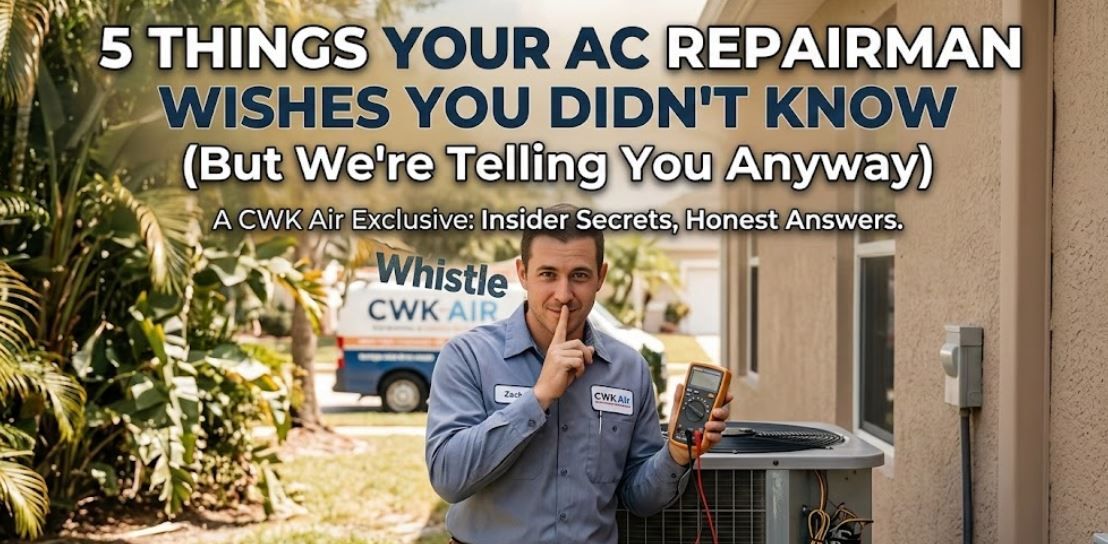
5 Things Your AC Repairman Wishes You Didn’t Know
A Message from Your Honest Florida AC Experts at CWK Air Conditioning & Heating
It’s the hottest day of July in Florida. Your living room temperature is creeping past 82 degrees. You’ve just discovered a puddle of water under your air handler in the closet. The anxiety immediately sets in. You know you need professional help, but a little voice in your head whispers, "How much is this going to cost me, and can I trust who I call?"
At CWK Air, we get it. We are a family-owned and operated business serving the Spring Hill and Nature Coast area. We know our neighbors. We also know the reputation the HVAC industry sometimes has—the image of corporate "upsellers" who diagnose a "dead compressor" when a 10-cent wire loose was the real culprit.
We have built our business on trust, transparency, and treating our customers like family. We’ve watched our community grow, and we’ve seen how corporate-owned, high-pressure service companies operate. Their technicians are often on commission, incentivized to turn a simple repair into a system replacement.
We don't operate that way. Today, we’re doing something different. We are pulling back the curtain. Here are five crucial things many HVAC companies wish you didn’t know, but we believe are vital for every Florida homeowner to understand.
1. You Don't Always Need a Service Call to Reset Your System (The $100 Secret)
This is the call that always makes us sigh—both for the customer’s wallet and for our technician’s schedule. Your system is "completely dead." The thermostat is blank. Nothing is moving. The automatic assumption is a total system failure.
What they wish you didn’t know: Sometimes, your entire system failure is just a tripped safety switch or breaker. In Florida, sudden power surges from thunderstorms often trip breakers, particularly the ones feeding the condensing unit outside. Your indoor unit might also have a float switch in the drain pan (see section 2) that has cut power because it’s full of water.
A technician can charge you $79 to $129 (or more on weekends) just to show up, walk to your electrical panel, reset the correct breaker, and walk away in 90 seconds. We encourage our customers to perform a simple 3-step check first:
- Check your thermostat battery. (Often a blank screen just means dead AAs).
- Check your main electrical panel. Are any breakers labeled "A/C," "AC COND," or "HEAT PUMP" in the center (tripped) position? Flip it fully OFF, then fully ON.
- Check the drain line float switch. If the secondary drain pan under your indoor unit is full of water, that little floating hockey-puck looking device has cut off the low voltage to your system to prevent a flood. This means you have a clog (which might need a pro), but resetting the breaker won't fix this.
2. Florida Humidity Actively Sabotages One Specific, Cheap Component
Our unique local climate doesn’t just make us uncomfortable; it is fundamentally hostile to the materials that run your air conditioner. While many generic HVAC blogs talk about general dust or old age, in Spring Hill, our enemy is relentless humidity combined with airborne contaminants like mold spores.
What they wish you didn’t know: The most common cause of a system shutdown on a super hot day isn't a dead compressor, it's a clogged condensate drain line causing the float switch to trip (referencing back to section 1). The humidity wrings massive amounts of water from the air, creating a warm, wet, dark environment inside your drain line. This is a perfect breeding ground for "algae bloom" and slime.
This blockage is a simple fix. We clean them constantly. High-pressure sales companies might claim this is a symptom of a larger, expensive drainage design flaw required to bring your system up to current code. In 90% of cases, it’s just a slime clog that we clear quickly and affordably. We also teach our customers how to prevent it safely.
3. The Truth Behind '20-Year Warranties' and Factory Parts
You see the ads everywhere: "20-Year No-Hassle Warranty" or "Lifetime Compressor Guarantee." These headlines offer incredible peace of mind when you are considering an expensive investment.
What they wish you didn’t know: Those headlines have asterisks. The most important details are often buried deep in the small print, specifically:
- You Must Register the System: Most major manufacturers (Trane, Carrier, Goodman, etc.) require that you register your new equipment online within 60 to 90 days of installation. If you or your installer forgets this step, your 10-year factory warranty often instantly drops to 5 years. High-pressure companies sometimes omit this detail, knowing they can charge you for parts in year 6. (CWK Air registers every system we install for you.)
- Warranties Are for PARTS, Not Labor: This is the massive gap. If your compressor dies in year 7, the manufacturer may send us the replacement compressor for free, but you are still responsible for the 4+ hours of skilled labor, the expensive refrigerant recovery and recharge (which has skyrocketed in price), and associated supplies (filters, driers, etc.). That "free" part can still cost $1,500+ in labor and materials.
- The Fine Print on "No-Name" or "Universal" Parts: Some companies use generic, universal capacitors or contactors because they are cheaper than OEM (Original Equipment Manufacturer) factory parts. When these generic parts fail—which they often do prematurely in Florida’s 24/7 run cycle—the company gets another service call. We prioritize OEM parts for reliability.
4. A 'Slight Freon Leak' is Always a Lie (And Often Illegal)
This is the classic, old-school service call red flag. The technician hooks up gauges, frowns, and says, "It’s looking low on Freon (refrigerant). I’ll just add a couple of pounds for $300 and that should get you through the summer."
What they wish you didn’t know: Your HVAC system is a hermetically sealed closed loop. It does not "consume" or "burn" refrigerant. If it is low, it means there is a leak. Period.
Adding refrigerant without finding and fixing the leak is like filling a tire with a giant nail in it. Furthermore, section 608 of the Clean Air Act makes it generally unlawful to knowingly vent ozone-depleting substances or their substitutes. While small residential systems have slightly nuanced rules, "topping off" a known leak indefinitely is a violation of environmental law and is terrible service.
They wish you didn't know that instead of a simple $300 recharge, the correct repair is a leak search (often involving nitrogen and specialized dyes) to find the cracked copper or failing coil. Then, you repair the leak or replace the component. "Topping off" is just a high-profit band-aid that guarantees another expensive call next month.
5. Why the Best Price Quote on a New System Can Be the Most Expensive Decision
When you are spending $6,000 to $10,000 on a new AC system, your first instinct is to get three quotes and pick the lowest price.
What they wish you didn’t know: The lowest bid is almost always omitting critical steps that affect the life and efficiency of the system.
A large portion of the cost of installation is skilled labor. The low bidder might cut corners that you can’t see until 2 years later:
- Reusing Old Components: They may reuse your original copper lineset (which is sized incorrectly for modern refrigerants) or your old electrical disconnect box, rather than running a clean install.
- Poor Ductwork Integration: A complex high-efficiency system is worthless if it is hooked up to leaky, undersized 30-year-old ductwork. Low bidders rarely account for duct repairs.
- Incorrect System Sizing: They may simply "swap out" the 3-ton unit you have for another 3-ton unit, without performing a proper "Manual J Load Calculation." Florida homes built in the 70s are different from homes built in 2020. Incorrect sizing is the main cause of short-cycling, humidity issues, and premature component death.
We aim to be competitive, but we will not compromise on the installation process. We install to code, ensure your ductwork is ready, perform the necessary calculations, and back up our work. The cheapest install today is the one you must replace five years sooner.
We Believe in Transparency
At CWK Air, we don’t need secrets. We believe that by educating our customers, we build a smarter community that values honest work. When you call us, you are calling a family business that intends to be here serving Spring Hill for decades, not just until the end of this heat wave.
If you are facing a confusing AC issue, give us a call at (352) 683-1139. We’ll give you the straight answers, not a sales pitch. We treat your home like our own.